The Return to sport framework
that school never gave you.
Get your athletes back to sport without the nights spent worrying about how you’re going to progress them safely. The RTS Blueprint teaches you how to understand what sport truly demands of athletes - and how to prepare them best for it.
Join 500+ clinicians!
Built for the 95% of clinicians who want clarity, not complexity
In this short video, I'll walk you through exactly what you can expect in the Blueprint.
Most clinicians spend years piecing this together. The Blueprint gives you the whole system in one sitting.

blueprint
-
When in doubt, principles provide a place to return to when you feel lost in a plan of care. Learn the 10 principles that drive the RTS system and how you can implement them in your own practice.
Learn the Four Phases of return to sport, and why standard rehab usually doesn’t get past phase 2.
See sports differently through the lens of six distinct plan of care pillars.
-
Most clinicians view rehab progressions as exercises that you need to memorize. However, if you learn the principles of progression - you can endlessly tinker with exercises until you get exactly what you want.
Lessons include:
Rules of exercise progressions and regressions
How to make any exercise harder
How to make any exercise easier
Applying the progression dials to strength exercises
-
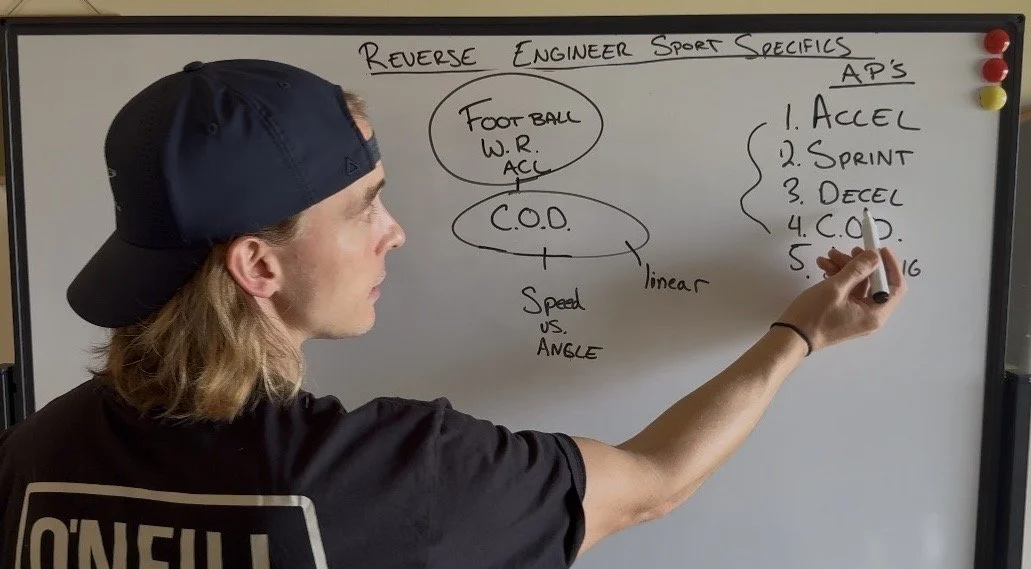
Sport demands more than strength and range of motion. In this chapter, we take a deep dive into the 5 major athletic patterns. We look at coaches eye breakdowns, lectures, and exercise progressions of each of the main movement patterns of sport:
Acceleration
Deceleration
Sprinting
Change of Direction
Jumping
-
How do you balance sport specificity vs. general training principles? When do you start working on multidirectional qualities in rehab? These questions and more are answered in this chapter!
-
The closing chapter focuses on the big decisions that come up in rehab, like:
How do you know when a patient is safe to return to sport after ACL?
Is there a better return-to-run program than a walk:jog ratio? (hint: yes, and I give it to you)
Does patient context fit in to my return to sport decisions, or should I only clear off testing scores alone?
How do I deal with patient or surgeon questions during the clearance process?
-
This is built for physical therapists, athletic trainers, DPT students, and sports medicine clinicians who treat athletes and want a clearer framework for return to sport programming. If you work in outpatient sports PT — whether in a high-end performance facility or a standard neighborhood clinic — this course was designed with your environment in mind.
-
The Blueprint is designed as a continuing education course for movement professionals (PTs, ATs, Personal Trainers, etc.).
It is not designed as a do-it-yourself rehab program.
Please see my program Return to Impact.
-
You’ll have lifetime access to the Blueprint. This includes all future updates (of which there have already been a handful). Any price increase on the Blueprint will not affect you - you’ll be locked in for life!
-
Not yet. CEU accreditation is actively in development and expected in 2027. When it launches, the price will reflect it.
If you buy the Blueprint now, you lock in the current rate and will receive CEU access at no additional cost when it becomes available.
Frequently asked questions
-
Plan on giving yourself a weekend. It’s ~1.5 hours of video content, with added handout material as well. You can binge it all at once if you want, but make sure to take notes and reflection points to get the most out of it.
-
Even experienced clinicians tell us the Blueprint reframes things they thought they already knew. If you have been figuring this out through trial and error, the framework gives language and structure to the instincts you have already developed, and fills the gaps you did not know were there.
-
Most CEU courses teach you techniques. The Blueprint teaches you how to think. Rather than giving you a protocol to follow, it gives you a framework for designing and progressing your own programming (not to mention at a fraction of the price).
-
No. The entire framework is built around principles, not equipment. I developed most of this working in small outpatient clinics with resistance bands, light dumbbells, and 40-minute sessions. The progressions and movement patterns in the Blueprint work in any clinic space.
Still Have Questions?
I’m here to help.
If you’re not sure if the Blueprint is right for you—drop me a line.
You’ll hear back from me shortly.
Let’s get you treating athletes with clarity.
- Sean